Showing posts with label Nawaz Sharif. Show all posts

Four officers likely to be called back from India

ISLAMABAD: The government is considering pulling out from India four of its officers posted in Pakistan’s High Commission in New Delhi, days after Indian authorities declared one official persona non grata.
“This is under consideration. A final decision would be taken shortly,” a source at the Foreign Office said on Monday.
The names of the officers — commercial counsellor Syed Furrukh Habib and first secretaries Khadim Huss­ain, Mudassir Cheema and Shahid Iqbal — were made public after Indian officials released to media a recorded statement of a high commission staffer Mehm­ood Akhtar, who was expelled from India after being declared persona non grata.
Mr Akhtar told Dawn that he had given the statement under duress.
“They took me to a police station after detaining me where I was forced to read out a written statement provided by them in which the names of the four officers were given and was told to state that they belonged to Pakistan’s intelligence services,” the former high commission official, who returned to Islamabad last week, said.
Mr Akhtar narrated how he was manhandled and picked from outside a zoo while on his way back from Nizamuddin shrine and taken to a Delhi police station, where he was coerced into recording a statement before being expelled from the country.
Indian officials, he said, tortured him to extract the statement and threatened to inject him with heart attack inducing injection if he refused to comply.
The incident has jeopardised the security of the officers and their families besides restricting the normal diplomatic functioning of the high commission.
Pakistan and India have in the past expelled each other’s diplomats and officials due to their tense relationship, but it is one of those rare occasions where one of the countries took the extreme step of revealing the identities of officers.
Pakistani officials believe that India did this on purpose to heighten the tensions.
“We consider it as a serious breach of diplomatic norms. The Indian move has complicated the already tense situation and threatened the lives of our diplomatic staff,” an officer said, adding it was a “deliberate and provocative action”.
Talking about the difficulties being faced by high commission staff, the officer said a son of one of the officers had to be taken back from school after he was ridiculed by his class fellows following this disclosure.
He said public attitude towards high commission staff had stiffened.
One of the family members of the staff earlier talking over the phone to Dawn criticised the Pakistan government for “not proactively and forcefully” responding to the threats to their safety. “It is a matter of life and death for us, but the government’s response has been too meek,” the family member said.

Pakistan to expel Indian diplomat in tit-for-tat move

The Foreign Secretary on Thursday summoned the Indian High Commissioner today and conveyed the decision of the Government of Pakistan to declare Surjeet Singh, an official of the Indian High Commission, as persona non grata, said a statement released by the Foreign Office.
The statement added that the Foreign Secretary expressed deep concern over the activities of the Indian official that were in violation of the Vienna Convention and established diplomatic norms.
“The Indian High Commission has been asked to make urgent necessary arrangements for Surjeet Singh and his family to leave Pakistan by October 29, 2016.”
Earlier today, India decided to expel a Pakistani high commission staff member for “espionage activities”, a foreign ministry official said, as local media reported that New Delhi police had detained him.
The Indian foreign secretary summoned Pakistani ambassador to India Abdul Basit to inform him that a Pakistan High Commission staffer has been declared persona non grata for espionage activities, Spokesperson of Indian Ministry of External Affairs Vikas Swarap said in a tweet.
Delhi police crime commissioner Ravindra Yadav said the official had been detained on Wednesday with defence and other documents in his possession.
The documents included information on deployment of India's border security forces, Yadav told a press conference.
A Pakistani diplomatic source said the visa official, named as Mehmood Akhtar, had been given 48 hours to leave the country.
Akhtar was released in about three hours on intervention by our High Commission, the Foreign Office said.
Two other officials, identified as Maulana Ramzan and Subhash Jangir, have also been arrested for allegedly passing on sensitive information to the staffer.
Pakistan High Commissioner Abdul Basit "strongly protested with Indian Foreign Secretary at the detention and manhandling of Pakistan High Commission staff," a spokesperson of the Pakistan High commission in Delhi said.
The high commissioner also said the detention contravened the 1961 Vienna Convention.
He asked the Indian government to ensure that such harassment does not happen in the future and strongly rejected accusations of the Indian government.
“Pakistan never engages in activity that is incompatible with its diplomatic status,” the envoy said.
"This act clearly reflects Indian actions to shrink diplomatic space for the working of Pakistan High Commission," the FO said.

Pakistan bans all Indian TV and radio as tensions mount

Pakistan has banned all television and radio content from India and threatened to shut down any stations that flout the sanction.
The ban drew immediate criticism from cable operators and viewers in Pakistan, where Indian soaps and Bollywood films are popular.
It follows a souring in relations between the south Asian neighbors.
Tensions have run high since India cracked down on protests in Indian-administered Kashmir in July.
Relations worsened in September when militants attacked an army base there, killing 18 soldiers.
India accuses Pakistan of arming and training insurgents fighting for Kashmir's independence from India or its merger with Pakistan - a claim Pakistan denies.
Pakistan's blanket TV and radio ban follows a tit-for-tat series of restrictions in both countries' respective media industries.
There were calls in India after the Kashmir attack for a ban on Pakistani actors and actresses in the country's Bollywood film industry.
Pakistani cinemas responded by banning Bollywood films and some Indian channels.

Trump offers to help reduce India-Pakistan tensions

Trump offers to help reduce India-Pakistan tensionsWASHINGTON: Republican presidential candidate Donald Trump has said that if elected, he’d like to mediate between India and Pakistan because the region was a “very, very hot tinderbox”.
But like the Obama administration, Mr Trump also said that he would only mediate if both countries asked him to do so.
In a meeting with the Indian community in New Jersey this weekend, the Republican candidate promised that if voted to power, he would make the United States and India “the best of friends” and they would have a “phenomenal future” together.
“There isn’t going to be any relationship more important to us,” he added.
Later, in an interview to The Hindustan Times, Mr Trump expressed his desire to play a role in reducing India-Pakistan tensions.
“Well, I would love to see Pakistan and India get along, because that’s a very, very hot tinderbox,” he said. “That would be a very great thing. I hope they can do it.”
Mr Trump also referred to “the recent problem” in held Kashmir where Indian forces have killed more than 100 demonstrators since July and a terrorist attack in Uri brought the two countries close to yet another armed conflict.
Asked if he would like to play a role, he said, “If it was necessary I would do that. If we could get India and Pakistan getting along, I would be honoured to do that.”
He said that reducing tensions between South Asia’s two nuclear-armed nations would “be a tremendous achievement” and “if they wanted me to, I would love to be the mediator or arbitrator”.

Nothing against Pakistan’s people: Indian minister

NEW DELHI: Indian Home Minister Rajnath Singh said on Monday that Pakistan should close down what he termed a “factory of terrorism”, while offering India’s help to Islamabad in fighting terrorists.
He told a regional editors’ conference in Chandigarh that India had nothing against the people of Pakistan, but it was the state that had adopted terrorism as its policy.
“That is the reason it has been isolated not only in South Asia, but also in the world. India is ready to help Pakistan in taking action against terrorists in Pakistan. But for that Islamabad should close down ‘factory of terrorism’. This will open vistas of development and help in ensuring peace in South Asia,” Mr Singh said.
Referring to India’s claim of carrying out surgical strikes along the Line of Control against alleged terrorist launch pads, Mr Singh said it was a pre-emptive action and “India does not harbour any ill-will against the people of Pakistan”.
Mr Singh again said his government had decided to seal the border with Pakistan with physical and non-physical barriers by December 2018.
There is about 181.85km stretch in which construction of physical barriers is not feasible due to geographic constraints like riverine, low-lying, creek and marshy areas. In this stretch, advance technology solutions, including cameras, sensors, radars and lasers, will be deployed.
The Indian Border Security Force was testing the available technologies through pilot projects in Jammu, Punjab and Gujarat, the minister said.
“Pakistan’s entire establishment is engaged in fuelling terrorism in India and that’s why the management of areas along the Indo-Pak border has become a challenging task... But those who rear snakes should know they would bite them,” he said.
“If its intentions remain clear, India can help Pakistan carry out an anti-terror campaign, including (in Azad Kashmir). If Pakistan wishes it can seek our help and India is ready to help it... But its intentions are not clear,” Mr Singh said.
“This country shelters not just terrorists. It nurtures a mindset... that loudly proclaims that terrorism is justified for political gains.”

CPEC could become another East India Company

‘CPEC could become another East India Company’ISLAMABAD: Lawmakers from the upper house on Monday expressed the fear that the China-Pakistan Economic Corridor (CPEC) could turn into another East India Company if the country’s interests were not actively protected.
“Another East India Company is in the offing; national interests are not being protected. We are proud of the friendship between Pakistan and China, but the interests of the state should come first,” Senator Tahir Mashhadi, chairman of the Senate Standing Committee on Planning and Development, said when some committee members raised the concern that the government was not protecting the rights and interests of the people.
The East India Company was the British trading mission sent to India, which became the precursor to the British colonial presence in the subcontinent, eventually gaining power and overthrowing the Mughals who ruled India at the time.
Following a briefing by Planning Commission Secretary Yousuf Nadeem Khokhar, a number of committee members voiced their fears over what they perceived as the utilisation of local financing for CPEC projects, instead of funding from the Chinese or any other foreign investment. They also expressed concern over the fixing of power tariff for CPEC-related power projects by the Chinese.

Senators question why most corridor projects are being funded locally, not through foreign investment


Since only one of three Pakistan Muslim League-Nawaz (PML-N) members of the committee was present at the meeting, most of this criticism went unanswered. Even Senator Saeedul Hassan Mandokhail, the lone PML-N senator in attendance, endorsed the committee chairman’s complaints.
The meeting was informed that a major portion of the CPEC depended on local finances rather than Chinese investment.
“It will be very harmful for us if we have to bear the entire burden; will this [project] be a national development or a national calamity? Whatever loans taken from China will have to be paid by the poor people of Pakistan,” Mr Mashhadi observed.
Highlighting the status of CPEC-related power projects, the Planning Commission secretary said that the Matiari-Lahore transmission line project had “not been scrapped” and was being pursued by its Chinese sponsors.
Recently, the National Energy Power Regulatory Authority (Nepra) had approved tariff for the project, while the government’s Private Power Infrastructure Board had filed a review petition on the tariff in order to address the sponsors’ concerns.
At this, Senator Usman Khan Kakar pointed out that Nepra had fixed the power tariff for the project at 71 paisas/unit, while Chinese investors were demanding 95 paisas/unit.
“The government has filed an appeal before Nepra, seeking the increase despite the fact that the burden will be borne by poor consumers,” he said.
The secretary also informed the committee that the Gadani power plant complex had been shelved due to the lack of a dedicated jetty.
He also said that the 6,000MW project was not part of the CPEC.
Senator Kakar immediately reacted, saying that despite the fact that the project was not part of the CPEC, Chinese Ambassador Sun Weidong had recently claimed that the Gadani power plant had not been scrapped and was indeed a part of the corridor. “Why is this project, which does not even exist, being counted in our account?” he asked.
He said that the infrastructure being established in Gwadar would only benefit the Chinese and Punjab governments, not the local community. “The people of Balochistan will only get one benefit from this project, which is the water supply,” he said, adding that no electricity or railway projects had been planned for Balochistan under the CPEC.
Senator Mandokhail said that a sense of deprivation was being instilled in smaller provinces. “We do not want the CPEC at the cost of the federation,” he added.
Since Minister for Planning and Development Ahsan Iqbal was not present in the meeting, the senator urged the secretary to advise him to ensure the integrity of the federation.
Senator Mandokhail also accused the Planning Commission of prioritising Balochistan very low on its list, given that it has not representation in the commission itself.
Jamaat-i-Islami Emir Senator Sirajul Haq said that like certain other parts of the country, Fata and AJK were also being neglected in the CPEC. “There is nothing for both areas in the CPEC,” he said and suggested that a 35km road was built to link Muzaffarabad to the CPEC so that the people of AJK could also reap its benefits.

Scotland Yard drops money laundering investigation against Altaf Hussain


British investigative agency Scotland Yard on Thursday dropped investigations into the money laundering case against Muttahida Qaumi Movement (MQM) Chief Altaf Hussain in London.

Cases against senior MQM leader Mohammad Anwar and businessman Sarfaraz Merchant were also dropped by the Metropolitan Police. The cases were wrapped up due to lack of evidence.
Earlier in the month, the Metropolitan Police requested a two-week delay before deciding if they will try to confiscate cash found in the MQM’s UK headquarters and the London homes of Altaf Hussain and the businessman Sarfraz Merchant.
MQM leader Wasay Jalil tweeted, "We are thankful that Scotland Yard have decided to drop the money laundering case against Altaf Hussain."
The police found £167,525.92 in the MQM’s offices in London and a further £289,785.32 in Mr Hussain’s home. A smaller sum — around £30,000 — was found in Mr Merchant’s home.
The MQM supremo was arrested in the case on June 3, 2014 by the London Metropolitan Police. However, Altaf was released four days later.
He was granted four bail-extensions during the investigations:
  • July 2014
  • Dec 2014
  • April 2015
  • July 2015
During their investigations, the London Metropolitan Police had discovered ‘a considerable amount of money’ during raids on Hussain’s residence and office in London.

India to seal border, allows evacuated residents to return

NEW DELHI: India said on Friday it would completely seal the border with Pakistan by December 2018 and, in a sign that the military escalation could be abating, allowed evacuated local residents in Punjab to return home.
Home Minister Rajnath Singh said in Jaisalmer that all effective means, including technological solutions, would be used to seal off the border.
Speaking to media after reviewing the security situation on border with ministers and officials of four states, Mr Singh proposed setting up a border security grid for which suggestions have been invited from all the stakeholders concerned, including the states which share border with Pakistan.
“It is a new concept. We will be framing guidelines after getting suggestions from all stakeholders,” Mr Singh said.
He said under the action plan of sealing the border, technology would also be used. “Like we have riverine and Sir Creek area in Gujarat, there we will make maximum use of technology for effective sealing of border.”
Mr Singh chaired the meeting of officials of states along the border. The government also decided to stop evacuation of people from villages in six districts of Punjab within 10km of the border with Pakistan.
Punjab Chief Minister’s Adviser on National Affairs Harcharan Bains said Mr Singh conveyed the decision to Deputy Chief Minister Sukhbir Singh Badal at a meeting of the border states at Jaisalmer.
“The Punjab government has deci­ded to allow the people to return homes in the border areas. People who had to leave their homes following the earlier directive of centre government can now return to their homes,” he said.
In the wake of disputed surgical strikes by Indian army commandos inside Azad Kashmir, New Delhi had ordered evacuation of people from areas within 10km of the India –Pakistan border.
The state government has directed deputy commissioners of all districts concerned to take immediate steps to ensure smooth return of the affected people back to the border villages. The Centre had on Sept 29 asked the state to evacuate people residing in border villages, which included Ferozepur, Fazilka, Amritsar, Taran Tarn, Gurdaspur and Pathankot.
Meanwhile, the Punjab Congress has welcomed the reversal of evacuation orders, saying it vindicated the party’s stand that it was not required in the first place.
“Evacuations had been ordered to create war hysteria for vested political interests by the Akali-BJP alliance. Since the decision boomeranged on them, eventually they had to withdraw this,” said Capt Amarinder Singh, president of Punjab Congress.

US-India relations reason for Pakistan's burgeoning ties with Russia

WASHINGTON: Prime Minister's Special Envoy on Jammu and Kashmir Mushahid Hussain Syed, on a visit to the United States, said US-India relations are the reason for Pakistan's burgeoning ties with Russia.
In a program organised by the think tank Atlantic Council, Hussain said, "We [Pakistan] are observing a change in US diplomatic policy".
Hussain said every action has a reaction, and Pakistan felt the need to develop close ties with Russia after President Obama’s two visits to India.
“This was the start of a new chapter in Pakistan-Russia ties.”
The senator added that Russia is in favour of building a working relationship with countries of the region and it has also started a dialogue process with Afghan Taliban through back-door cha
nnels.
He said the US State Department had refused to give visa to then Gujrat Chief Minister Narinder Modi in 2006, but when Modi was elected as Indian Prime Minister, US changed its policy for political gains.
"This U-turn of US policy can be traced back to the time of Bush administration, when the US-India nuclear deal was signed which was against the law of non-proliferation of nuclear weapons," said Hussain.
"Stability of Afghanistan and eradication of terrorism is a top priority of the US, which needs Pakistan to play a role in the peace-process. Pakistan is not only providing its assistance in the peace process but also facing damages," stated the senator while addressing the audience.

Violating Indus Waters Treaty will be an act of war

The senator stated India can not violate the Indus Waters Treaty, as that will constitute as an act of war.
"Apart from Pakistan and India, the World Bank is also a stakeholder in the treaty," said Hussain.
Commenting on the Uri attack in India-held Kashmir, Husain said, "UN military observer group for India and Pakistan should investigate the Uri attack. Crossing the Line of Control to attack any target in India is not possible for any militant."
He added that if India has any evidence or intelligence regarding the attack, it should be shared with Pakistan.
A contingent of Russian ground forces arrived in Pakistan earlier in September for the first ever joint Pak-Russian military exercise.
The two-week-long exercise is expected to continue until Oct 10. The exercises with Russian ground forces come at a time when tensions between Pakistan and India are running high following an attack on the Uri military camp in India-held Kashmir.
Around 200 military personnel of both countries will participate in the drills.

'Honour killings': Pakistan closes loophole allowing killers to go free

Activists of The Pakistan People's Party hold placards at rally to mark International Women's Day in Karachi on March 8, 2016Pakistan's government has closed a loophole allowing those behind so-called honour killings to go free.
New legislation means killers will get a mandatory life sentence.
Previously, killers could be pardoned by a victim's family to avoid a jail term. Now forgiveness will only spare them the death penalty.
It is being seen as a step in the right direction in a country where attacks on women who go against conservative rules on love and marriage are common.
According to the independent Human Rights Commission of Pakistan (HRCP), nearly 1,100 women were killed by relatives in Pakistan last year in such killings, while many more cases go unreported.
The loophole allowed the perpetrators of "honour killings" - often a relative acting on the pretext of defending family "honour" - to avoid punishment because they can seek forgiveness for the crime from another family member.

Pakistan and 'honour killings'


'First step'

In recent months, a number of high-profile deaths have made headlines both in Pakistan and abroad, including the killing of British woman Samia Shahid in July, allegedly by her father and her former husband.
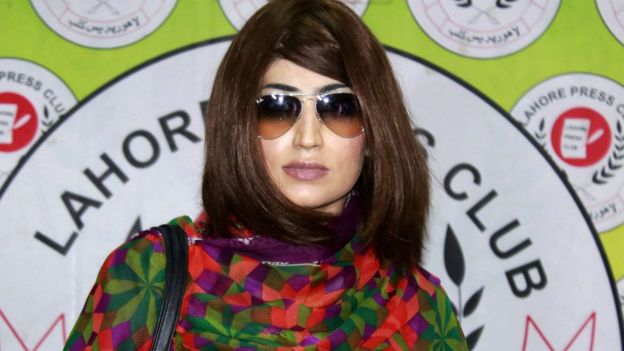
Qandeel Baloch - a social media star in Pakistan - pictured shortly before her deathThe same month, Pakistani social media celebrity Qandeel Baloch was strangled to death, allegedly killed by her brother in the province of Punjab.
The amended law was debated by Pakistan's National Assembly for four hours on Thursday, before being passed unanimously.
Campaigners have been calling for tougher legislation to protect women from violence for years.
A 2005 amendment to the law pertaining to "honour killings" prevented men who kill female relatives pardoning themselves as an 'heir' of the victim.
Pakistani activist and filmmaker Sharmeen Obaid - who won an Oscar earlier this year for a documentary on "honour killings" - paid tribute to the people who had worked to get the bill through.
"It may not change much over night but it is certainly a step in the right direction," she said in a Facebook post. "And today I am proud that we have gone the distance on this bill."
Others were more cautious, raising concerns over the fact the bill still allows a judge to decide whether a murder qualifies as an 'honour killing' or not.

Top UN court rejects Marshalls nuclear case against Pakistan, India

THE HAGUE: The United Nation's (UN) highest court Wednesday threw out a bid by tiny Marshall Islands to sue Pakistan for “failing to halt the nuclear arms race”, moments after rejecting a similar case against India.
“The court upholds the objection to jurisdiction raised by Pakistan based on the absence of a dispute between the two parties,” judge Ronny Abraham told the International Court of Justice in The Hague, and “cannot proceed to the merits of the case".
The 16-judge bench at the ICJ however was also to rule later in the day in a separate decision on whether the Pacific island nation's David-versus-Goliath battle could continue against Britain.
The archipelago is seeking to shine a fresh spotlight on the global threat of nuclear weapons.
But in a majority verdict by nine votes to seven “the court upholds the objection to jurisdiction raised by India”, presiding judge Ronny Abraham said, and therefore the tribunal “cannot proceed to the merits of the case.”
The tribunal, set up to resolve rows between nations, found it lacked the jurisdiction in the case as there had been no prior recorded dispute or negotiations over the nuclear issue between the Marshall Islands and India.
The tiny Pacific island nation was ground zero for a string of nuclear tests on its pristine atolls between 1946-58, carried out by the United States as the Cold War arms race gathered momentum.
Initially in 2014, Majuro accused nine countries of failing to comply with the 1968 nuclear Non-Proliferation Treaty, which seeks to inhibit the spread of atomic bombs.
But the ICJ already failed to take up cases against the other countries ─ China, France, Israel, North Korea, Russia and the United States ─ as they have not recognised the court's jurisdiction. Israel has also never formally admitted to having nuclear weapons.
The Marshall Islands has maintained that by not stopping the nuclear arms race Britain, India and Pakistan continued to breach their obligations under the treaty — even if New Delhi and Islamabad have not signed the pact.
The treaty commits all nuclear weapon states “to pursue negotiations in good faith on effective measures relating to cessation of the nuclear arms race at an early date and to nuclear disarmament”.
Majuro is calling for nuclear powers to take “all necessary measures” to carry out what it considers to be their obligations under the treaty.

'Islands vaporised'

At a March hearing, Majuro's lawyers painted a vivid picture of the horrors seen after 67 nuclear tests were carried out on Bikini and Enewetak atolls.
“Several islands in my country were vaporised and others are estimated to remain uninhabitable for thousands of years,” Tony deBrum, a former Marshall Islands foreign minister, told the court.
The so-called “Operation Castle” tests in March and April 1954 were particularly devastating and resulted in massive contamination because of the nuclear fall-out.
“The entire sky turned blood-red,” said deBrum, who witnessed the explosion of the largest-ever US-built nuclear device called “Castle Bravo” as a nine-year-old boy.
Critics have argued however that the ICJ action is a distraction and that the islanders' real fight is with Washington, which carried out the tests in their backyard.
They contend that the case has no relation to the victims' claims for increased compensation, better health care and clean-ups to render the sites habitable again.
Experts however say the islands hoped the three cases before the ICJ will thrust nuclear disarmament talks, which have stalled over the past two decades, back into the spotlight.
Even if the case has no direct impact, the Marshall Islands' residents “perhaps feel that the more the difficulties with nuclear weapons are brought to the public consciousness, the better,” said Jens Iverson, assistant professor of Public International Law at Leiden University.
“They may hope that the world may become a safer place,” Iverson told AFP.

Related Posts Plugin for WordPress, Blogger...