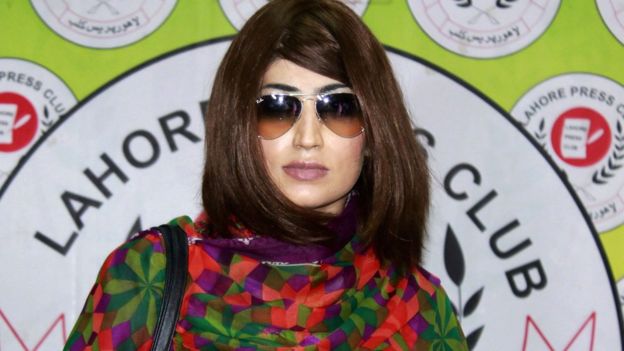
'Honour killings': Pakistan closes loophole allowing killers to go free

Activists of The Pakistan People's Party hold placards at rally to mark International Women's Day in Karachi on March 8, 2016Pakistan's government has closed a loophole allowing those behind so-called honour killings to go free.
New legislation means killers will get a mandatory life sentence.
Previously, killers could be pardoned by a victim's family to avoid a jail term. Now forgiveness will only spare them the death penalty.
It is being seen as a step in the right direction in a country where attacks on women who go against conservative rules on love and marriage are common.
According to the independent Human Rights Commission of Pakistan (HRCP), nearly 1,100 women were killed by relatives in Pakistan last year in such killings, while many more cases go unreported.
The loophole allowed the perpetrators of "honour killings" - often a relative acting on the pretext of defending family "honour" - to avoid punishment because they can seek forgiveness for the crime from another family member.

Pakistan and 'honour killings'


'First step'

In recent months, a number of high-profile deaths have made headlines both in Pakistan and abroad, including the killing of British woman Samia Shahid in July, allegedly by her father and her former husband.
Qandeel Baloch - a social media star in Pakistan - pictured shortly before her deathThe same month, Pakistani social media celebrity Qandeel Baloch was strangled to death, allegedly killed by her brother in the province of Punjab.
The amended law was debated by Pakistan's National Assembly for four hours on Thursday, before being passed unanimously.
Campaigners have been calling for tougher legislation to protect women from violence for years.
A 2005 amendment to the law pertaining to "honour killings" prevented men who kill female relatives pardoning themselves as an 'heir' of the victim.
Pakistani activist and filmmaker Sharmeen Obaid - who won an Oscar earlier this year for a documentary on "honour killings" - paid tribute to the people who had worked to get the bill through.
"It may not change much over night but it is certainly a step in the right direction," she said in a Facebook post. "And today I am proud that we have gone the distance on this bill."
Others were more cautious, raising concerns over the fact the bill still allows a judge to decide whether a murder qualifies as an 'honour killing' or not.

Hurricane Matthew: Hundreds dead in Haiti storm disaster

Destroyed houses are seen after Hurricane Matthew hit JeremieThe death toll in Haiti as a result of Hurricane Matthew has soared to 283, the government says.
Some 50 people were reported to have died in the southern town of Roche-a-Bateau alone.
The peninsula's main city, Jeremie, saw 80% of its buildings levelled. In Sud province 30,000 homes were destroyed.
The hurricane has again been upgraded to a Category Four storm, the second highest hurricane classification, as it heads for the US state of Florida.
The new death toll was given by Haitian government officials. On Thursday, a toll of just over 100 was being given.
Hurricane Matthew - the most powerful Caribbean storm in nearly a decade - has pounded the Bahamas after slicing through Haiti and Cuba.
Trees and power lines were reportedly down in the Bahamas but no fatalities were reported.
Most of the fatalities in Haiti were in towns and fishing villages around the southern coast, with many killed by falling trees, flying debris and swollen rivers.
The storm passed directly through the Tiburon peninsula, driving the sea inland and flattening homes with winds of up to 230km/h (145mph) and torrential rain on Monday and Tuesday.
The collapse of an important bridge on Tuesday had left the south-west largely cut off.
Non-governmental organisations said phone coverage and electricity were down and people were running out of food and water.
The BBC's Tony Brown in south-western Haiti said he had seen people trying to cope with the mass destruction on their own, trying to rebuild from the rubble but without the help of the army or police.
Map shows Hurricane Matthew's path from the Bahamas heading towards Florida and other US eastern statesAcross the country, there were some 350,000 in need of assistance, according to the UN Office for the Coordination of Humanitarian Affairs.
A spokesperson for the American Red Cross, Suzy DeFrancis, said the first priority was to get phone networks across the country back up and running.
"We will bring in technology to help do that," she said.
"We also have warehouses with relief supplies that we will be distributing. Some of the needs that families may have are kitchen kits so they can cook meals, any kind of hygiene kits and then we are most worried about cholera, so we will be helping to distribute aqua tabs to purify the water."
The country is one of the world's poorest, with many residents living in flimsy housing in flood-prone areas.
Four people also died in the storm in the neighbouring Dominican Republic on Tuesday.

Top UN court rejects Marshalls nuclear case against Pakistan, India

THE HAGUE: The United Nation's (UN) highest court Wednesday threw out a bid by tiny Marshall Islands to sue Pakistan for “failing to halt the nuclear arms race”, moments after rejecting a similar case against India.
“The court upholds the objection to jurisdiction raised by Pakistan based on the absence of a dispute between the two parties,” judge Ronny Abraham told the International Court of Justice in The Hague, and “cannot proceed to the merits of the case".
The 16-judge bench at the ICJ however was also to rule later in the day in a separate decision on whether the Pacific island nation's David-versus-Goliath battle could continue against Britain.
The archipelago is seeking to shine a fresh spotlight on the global threat of nuclear weapons.
But in a majority verdict by nine votes to seven “the court upholds the objection to jurisdiction raised by India”, presiding judge Ronny Abraham said, and therefore the tribunal “cannot proceed to the merits of the case.”
The tribunal, set up to resolve rows between nations, found it lacked the jurisdiction in the case as there had been no prior recorded dispute or negotiations over the nuclear issue between the Marshall Islands and India.
The tiny Pacific island nation was ground zero for a string of nuclear tests on its pristine atolls between 1946-58, carried out by the United States as the Cold War arms race gathered momentum.
Initially in 2014, Majuro accused nine countries of failing to comply with the 1968 nuclear Non-Proliferation Treaty, which seeks to inhibit the spread of atomic bombs.
But the ICJ already failed to take up cases against the other countries ─ China, France, Israel, North Korea, Russia and the United States ─ as they have not recognised the court's jurisdiction. Israel has also never formally admitted to having nuclear weapons.
The Marshall Islands has maintained that by not stopping the nuclear arms race Britain, India and Pakistan continued to breach their obligations under the treaty — even if New Delhi and Islamabad have not signed the pact.
The treaty commits all nuclear weapon states “to pursue negotiations in good faith on effective measures relating to cessation of the nuclear arms race at an early date and to nuclear disarmament”.
Majuro is calling for nuclear powers to take “all necessary measures” to carry out what it considers to be their obligations under the treaty.

'Islands vaporised'

At a March hearing, Majuro's lawyers painted a vivid picture of the horrors seen after 67 nuclear tests were carried out on Bikini and Enewetak atolls.
“Several islands in my country were vaporised and others are estimated to remain uninhabitable for thousands of years,” Tony deBrum, a former Marshall Islands foreign minister, told the court.
The so-called “Operation Castle” tests in March and April 1954 were particularly devastating and resulted in massive contamination because of the nuclear fall-out.
“The entire sky turned blood-red,” said deBrum, who witnessed the explosion of the largest-ever US-built nuclear device called “Castle Bravo” as a nine-year-old boy.
Critics have argued however that the ICJ action is a distraction and that the islanders' real fight is with Washington, which carried out the tests in their backyard.
They contend that the case has no relation to the victims' claims for increased compensation, better health care and clean-ups to render the sites habitable again.
Experts however say the islands hoped the three cases before the ICJ will thrust nuclear disarmament talks, which have stalled over the past two decades, back into the spotlight.
Even if the case has no direct impact, the Marshall Islands' residents “perhaps feel that the more the difficulties with nuclear weapons are brought to the public consciousness, the better,” said Jens Iverson, assistant professor of Public International Law at Leiden University.
“They may hope that the world may become a safer place,” Iverson told AFP.

India slow to expand Iran port

When the leaders of India, Iran and Afghanistan gathered in Tehran in the spring for a ceremony marking India’s development of a strategic Iranian port, they recited Persian poetry and said their partnership would “alter the course of history”.
On a recent visit, roughly 13 years after India first agreed to develop the port of Chabahar, a single ship floated at the main jetty. Most of the cargo containers scattered in an asphalt lot bore the logo of the state-owned Islamic Republic of Iran Shipping Lines. In an adjacent harbour, a dozen wooden dhows, or traditional fishing boats, bobbed in the water.
Months after the ceremony in May and pledges by India to inject $500 million into the project, the much-heralded port of Chabahar remains a sleepy outpost — as well as a shadow of the Chinese-built port of Gwadar, 100 kilometres to the east across Iran’s border with Pakistan.
“What you’re seeing is the problem with many of the Indian commitments abroad,” said Sameer Patil, an analyst at Gateway House, a research organisation in Mumbai. “Once a prime minister makes that commitment, the parties find it difficult to move the process forward. The Indian bureaucracy takes its sweet time.”
Chabahar was supposed to be an easy win: India would bankroll a hub to rival the China-Pakistan partnership at Gwadar, Iran would get a major ocean port outside the Strait of Hormuz and spur growth in its poor eastern region, and Afghanistan would gain road and rail links to a deep-water port that could boost its war-ravaged economy. But more than a decade on, the strategic asset is languishing, even as China sinks $45 billion into the China-Pakistan Economic Corridor that winds down to Gwadar.
“They should’ve given the contract to the Chinese,” said Zheng Ke, a 37-year-old businessman from China, speaking in Persian at his supermarket in Chabahar’s free trade zone as Iranian customers snapped up Chinese-made clothes and kitchen utensils and streamed through check-outs staffed by Chinese workers. “ They’d get the port done in no time.”
Despite the project’s importance, Indians and Iranians haggled for two years over who would pay $30m of excise duties on port equipment imported into Iran, according to Iranian diplomat Hamid Mosadeghi.
“The slowness comes from these small things,” said Mosadeghi, who heads the economic section at Iran’s embassy in New Delhi. “Both sides want to expedite this.”
For Indian Prime Minister Narendra Modi, Chabahar could aid his goals of integrating South Asia’s economies and boosting India’s stature in the region. However, the slow pace of its development has drawn criticism.
“With China and Pakistan developing Gwadar just a few kilometres away, India cannot afford either delay or inattention to this vital port,” said Shashi Tharoor, a lawmaker with Congress Party and chairman of a parliamentary committee on foreign affairs.
Chabahar could be a linchpin for the region’s economy. It’s close to the western Indian ports of Kandla, Mundra and Mumbai and could help India’s farmers get cheaper access to fertilisers and other commodities from Central Asia and beyond.
“We are dependent substantially on urea, ammonia and fertilisers, and given Chabahar’s geographic proximity, the transport costs are negligible,” India’s ambassador to Iran, Saurabh Kumar, said in an interview in Tehran.
Chabahar is also crucial for landlocked Afghanistan. The deal includes a north-south railroad that could help the country exploit an estimated $1 trillion of untapped mineral wealth and reduce its reliance on aid.
India will invest $85m in equipment and lend $150m for the first phase, which includes two terminals and five jetties, according to Kumar. Transport ministers from Iran, India and Afghanistan met last week in New Delhi to assess progress.
“We have not fallen behind in the Chabahar port development plans,’’ Iranian Transport Minister Abbas Akhoundi said after the meeting on Sept 28. “This plan is being carried out at the appropriate speed.”
Chabahar may even benefit China. The country, which deepened trade ties with Iran after the US and European Union tightened sanctions in 2012, could cash in on the gradual reopening of the Islamic Republic’s $400 billion economy.
Beijing is also expanding its footprint elsewhere in the Gulf: A unit of China’s biggest shipping group, Cosco Shipping Co, signed a deal on Sept 28 to build and operate a container terminal in the United Arab Emirates.
“There is a race,” said Patil, the Gateway House analyst. “But the ground reality is that the Chinese commitments in the region are already up and running, while Indian’s proposals remain proposals.”
For Iranians, the new investment can’t come soon enough. Sanctions, which were eased in January, exacerbated poverty in Sistan-Baluchestan, Iran’s poorest province, where security forces are fighting insurgents and face a threat from the militant Islamic State group allegedly from across the border in Pakistan and Afghanistan.
Once developed, Chabahar will be able to handle large cargo ships and will no longer need UAE ports to act as intermediaries by off-loading goods on to smaller boats.
The project will also lessen Iran’s vulnerability to possible disruptions in the Strait of Hormuz, said Abdolrahim Kordi, deputy head of economic affairs at the Chabahar Free Trade Zone. If the Strait, a shipping bottleneck at the mouth of the Gulf, were to be blocked due to regional hostilities, Chabahar would be “the only point that can connect Iran to open seas”, he said.
At Zheng’s supermarket overlooking the port, any payoff from Chabahar’s development remains a distant prospect.
“It’ll bring more goods here of course, but who knows when it’ll be done,” Zheng said.

Pakistan will win any war against India

A soldier stands next to a Pakistani flag. PHOTO: REUTERS
India has been threatening war against Pakistan but there is no war in which India can ever beat Pakistan. No Pakistani is afraid of war: Everyone is brave enough to put up a status online asking for war. As long as I do not have to fight in it, I support every war.

If it makes me feel better to upload a cover photo with the Pakistani flag, why should I care about helping to create social conditions where thousands of people can die? I do not even care about causing accidents on the road after painting both my car’s windscreens green and white.
In many ways, I am also a soldier. I have waged a war against India for a decade in Facebook comments. I am particularly proud of all the times I have referred to ‘India’ as ‘End ya’. In every cricket match after India loses a wicket I tweet the following: “India? Nahee, out dia.”
Do you think a country full of people who can come up with such hillarious puns can be defeated by a country where Katrina Kaif can win the Smita Patil Memorial Award?
Pakistan will win any war against India. World War I, World II, The American Civil War; we have never lost any war against India. In fact the worst Pakistani performance in a war was by the actors in Bilal Lashari’s Waar.
Even there we beat India. Anyone who saw the movie Border and thought no one can make a worse propaganda movie underestimated the power of Pakistanis.
There is a reason why we have the best spy agency in the world. Every single boy in Pakistan is trained in spy missions. Trying to pick up a girl from her house in Karachi without her mother noticing is nothing short of a James Bond mission. You have to disguise yourself as the driver, strategically park the car at an angle where her mother cannot spot it from the roof and if anybody approaches at a moment’s notice be ready to scream out, “Khuda ki kasam behan hay meri.”
For years the WWE has tried to warn us of the nefarious designs of India’s spy agency by screaming out to us ‘RAW is WAR’ but we never listened. We were blinded by uncle Aman’s daughter Asha and steamrolled by the Samjhota express.
Too long have we danced to the beat of India on all our mehndis anddholkis; too long have we asked our barbers to give us the Shahrukh Khan haircut; too long have we tried hiding our bellies in Salman Khan endorsed white ugly vests.
It is time we say enough is enough and engage in an all-out war against India. Every Pakistani is equal to 60 Indians and 2+2 = 22.
We will beat India on the cricket ground. We will beat India at the border. We will go to Mars and beat their satellite there. So what if we do not even get water in the most posh area of Karachi? Beliefs are stronger than science and I believe we will win. I am sure Agha Waqar can build us a satellite that runs on water.
Nawaz Sharif will beat Narendra Modi in an eating contest. Shahid Afridi will beat Sachin Tendulkar in a ‘will not retire’ contest. Humayun Saeed will beat Shahrukh Khan in a ‘will still play a 20 year old in movies’ contest.
Atif Aslam will beat Himesh Reshamiya in an auto tuning contest.
Bilal Khan will beat Katrina Kaif in a more fake British accent contest.
Imran Khan will beat Arvind Kejriwaal in a ‘trust me, we can still win’ delusion.
Mubasher Lucman will beat Arnab Goswami in a shouting match.
Every memon will beat Bappi Larri in wearing more gold in public.
Hamza Ali Abbasi will beat Subramanian Swamy in jingoism.
Every wall being used as a public toilet in Pakistan will defeat the Swachh Bharat movement.
We are the more hip choice for people worldwide. Pakistan – the new and improved India. We can build six Taj Mahals – even if that means spending no money on building schools and hospitals. If it means being better than India then I am sure all people dying from lack of adequate healthcare will understand.
India better not challenge us to another war. There is no way they can defeat us. We will have applications pending for visas for other countries. Every Pakistani will be willing to fly a plane over India, all the way to Australia for safe asylum.
India cannot isolate us from the West. We are the West. Every geographer in the world will tell you that Pakistan is closer to the West than India.

Islamic State chief Abu Bakr al-Baghdadi poisoned at feast

PHOTO: AFPIslamic State chief Abu Bakr al-Baghdadi and three of his top aides have fallen ill after being poisoned at a feast, Iraqi news agency WAAreports.
They have been shifted to an undisclosed location under strict measures, reports say. The lunch prepared for Baghdadi and three other Islamic State leaders was allegedly poisoned in Iraq’s Be’aaj district, it has been reported.
Earlier this year, the Pentagon warned Baghdadi that he would eventually “taste justice” as the US military continued to target the extremist group’s upper ranks. “We are hunting him, and we will find him,” military spokesperson Colonel Steve Warren said.
“Just like we found his mentor (Abu Musab) al-Zarqawi and killed him. Just like we found the grand master of terrorism, Osama bin Laden, we killed him. We are going to find Baghdadi, and he will taste justice,” he said.
Born in Iraq in 1971, Baghdadi emerged as the leader of an al Qaeda offshoot which later became Islamic State of Iraq and the Levant (ISIS), in 2010.
In 2015, Islamic State proclaimed its leader Baghdadi  as “caliph” – the head of the state.  Baghdadi aspires to establish a global caliphate with himself at its head.

Google Labeled India as Namak Haram Country India

Namak Haram Country India
Finally Google declare India as Namak Haram Country. We all know that India is a country which have worst in democratic Values and Dangerous for Muslims and women. India also earned a bad repute on diplomatic front. The reason of that is its underhand lobbying, cheating and bad moral values. Now the another shock for India is that Google labeled as the “Namak Haram country” India.

don't believe on it ? if you do not believe on this just go to Google search bar and Type “Namak Haram country” you will definitely astonished to see the result and given options by Google under search bar.
In a new development on the digital world that has viral on the Internet, users of internet have discovered this title of India that by typing ‘Namak Haram country’ on Google results in the Indian tricolor being displayed likes this “Namak haram Country India”

It’s a globally top story of Today, that world recognized India as Namak Haram Country, It means India is a Traitor Country and the reason is one and only PM Modi, and its current Govt. Who are against peace, love and development in the south Asia.

Google takes on Apple with unveiling of new Pixel phone

SAN FRANCISCO: Alphabet Inc's Google on Tuesday announced a new “Pixel” smartphone and a virtual reality headset, the company's latest effort to sell consumers on Google-branded devices and to challenge Apple Inc's iPhone at the high end of the more than $400 billion global market.
The new phone starts at a price of $649, and Google is working exclusively with Verizon Communications in the United States, Google executives said at a launch event in San Francisco.
Google's decision to launch with a single carrier echoes Apple's agreement to launch the original iPhone with AT&T, a deal that gave Apple unprecedented control over the look of the phone and how it worked.
While most vendors other than Apple use Google's Android operating system, the company has for years toyed with various approaches to building its own hardware without alienating manufacturers such as Samsung Electronics, the world's top smartphone maker.
Google also announced a “Daydream View” virtual reality headset, which will be available in November for $79, in time for the end-of-year shopping season.
Google hardware chief Rick Osterloh announced the Pixel phone shortly after the event began, adding that the camera was the best available on a smartphone. The new phone can get a 7-hour charge in 15 minutes, the company said.
Pixel phones will come in black, blue and silver and will have 5 and 5.5 inch (12.7 cm and 14 cm) screens. Google has sold another line of phones, called Nexus, since 2010, but the devices have gained little traction in a market dominated by Samsung Electronics.
Because its mobile software is available so widely, Google has struggled to distinguish its own devices, said analyst Jan Dawson of Jackdaw Research.
Google “wants to have this end-to-end experience, but it's not clear that people really want that,” Dawson said.
Shares of Alphabet were up about half a percent in midday New York trade. Shares of Verizon were down about 1 per cent.

Turkey says suspends 12,801 police over alleged links with cleric Gulen

Turkey says suspends 12,801 police over alleged links with cleric GulenANKARA: Turkish authorities have suspended 12,801 police officers from duty, police headquarters said on Tuesday, over their suspected links with the US based cleric Fethullah Gulen and his network, blamed by Ankara for orchestrating a failed coup in July.
The move came after the Interior Ministry launched an investigation into the police force, broadcaster CNN Turk reported, and a day after the Turkish government extended a state of emergency for another three months.
Of the total number of police suspended across the country, 2,523 were police chiefs, the statement said.
Turkey's total police force numbers about 250,000.
About 100,000 people in the military, civil service, police and judiciary have already been sacked or suspended in a post-coup crackdown, and some 32,000 people have been arrested for their alleged role in the abortive putsch.
President Tayyip Erdogan said last week Turkey would benefit from an extension to the three-month state of emergency declared after the failed July 15 coup, saying more time was needed to hunt down those responsible. He suggested it may last for more than a year.
However, the crackdown has raised concerns from rights groups and Western allies who fear Erdogan is using the failed coup as a pretext to curtail all dissent and to intensify his actions against suspected Kurdish militant sympathisers.
Turkey wants the United States to extradite Gulen and prosecute him on charges that he masterminded the attempt to overthrow the government. Gulen, who has lived in self-imposed exile in Pennsylvania since 1999, denies any involvement

White House shuts down anti-Pakistan petition

White House shuts down petition to designate Pakistan 'state sponsor of terrorism'WASHINGTON: The White House has shut down an ongoing petition that sought to designate Pakistan a state sponsor of terrorism, saying that it is doing so on suspicion of fraud.
In a blurb captioned, ‘Closed Petition’, the White House announced that the “petition has been archived because it did not meet the signature requirements. It can no longer be signed.”
The petition had, until October 21, to gather 100,000 signatures to merit a response from the White House under the rules of the programme that initiated such petitions.
At closure, the petition had 625,723 signatures, but the White House said the page might have included fraudulent signatures. The petition was hosted on a White House web page called “We the People”, which is open to all and, therefore, does not enjoy the security that protected government web pages do.
The petitioners, mostly US citizens of Indian origin, claimed that the designation was “important to the people of United States of America, India and many other countries which are continuously affected by Pakistan sponsored terrorism”.
The decision to end the petition hugely disappointed the Indian community in the United States, which was hoping to force the US administration to take a public position against Pakistan on this issue.
US officials, however, were also alarmed because the move had the potential of pitting citizens of Indian origin against those who came from Pakistan.
Last week, Pakistani-Americans too introduced a “We the People” petition, seeking to declare India a terrorist state for supporting militants in Balochistan, Fata and Karachi. The application is close to achieving the required 100,000 signatures.
White House officials, however, referred only to “technical issues with some of the signatures” while talking to various media outlets about why they decided to end the anti-Pakistan petition.
A separate legislation, moved in the US House of Representatives on Sept 20, also seeks to designate Pakistan a state sponsor of terrorist. The movers, Congressmen Ted Poe and Dana Rohrabacher, have a history of sponsoring anti-Pakistan resolutions. Most of their resolutions were defeated.

Related Posts Plugin for WordPress, Blogger...